
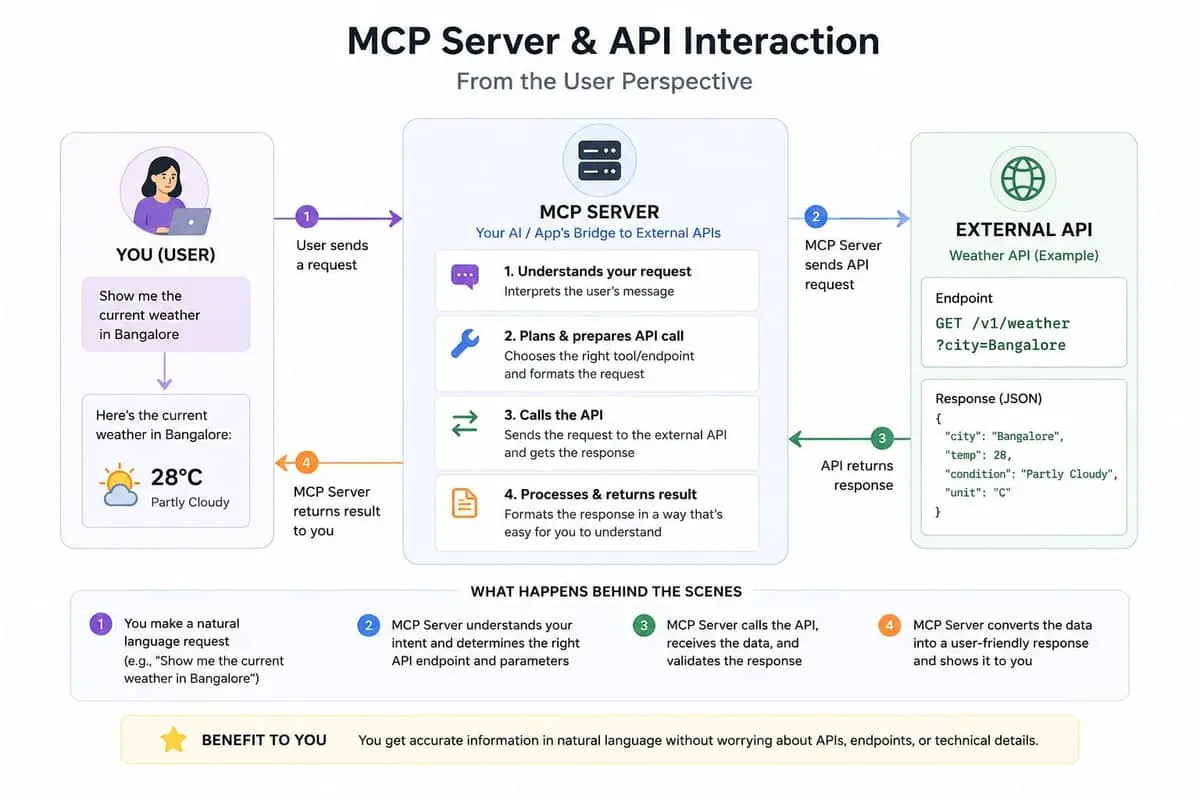
What is MCP?
The Model Context Protocol (MCP) is an open standard developed by Anthropic that enables AI models to securely access and act on data from external sources — databases, APIs, file systems, and business tools — through a unified interface. Think of it as a USB-C port for AI: a single, standardized connection that works with any service.
Before MCP, every AI integration required custom code for each data source. Need your LLM to query a PostgreSQL database? Write a custom connector. Need it to pull from Salesforce? Another connector. MCP replaces this fragmentation with one protocol that both the AI model and the data source speak natively.
How MCP Servers Work
An MCP server exposes three core primitives that an LLM can discover and use dynamically at runtime:
- Resources — data that can be read, like files, database records, or API responses. Resources are identified by URIs and can be fetched on demand.
- Tools — executable actions that the model can invoke, such as sending an email, creating a Jira ticket, or running a search query. Tools have typed parameters and return structured results.
- Prompts — pre-written templates that guide the model's behavior for specific tasks, like "summarize this document" or "analyze this customer feedback."
When an MCP client (the AI application) connects to a server, it first negotiates capabilities. The server advertises what resources, tools, and prompts it offers. The client can then browse available resources, invoke tools, and follow prompt templates — all without any hardcoded integration logic.
Architecture Overview
An MCP-based system has three layers:
- Host — the application the user interacts with (e.g., Claude Desktop, an IDE plugin, a custom chat interface).
- Client — a 1:1 connection from the host to a specific MCP server. The client handles transport, authentication, and message serialization.
- Server — a lightweight service that implements the MCP protocol for a specific data source or tool category.
Communication happens over JSON-RPC 2.0, with transport options including stdio (for local processes) and SSE (for remote servers). This makes MCP suitable for everything from local development tools to distributed enterprise systems.
Why It Matters
MCP eliminates the need for custom integrations between every AI application and every data source. One protocol, any model, any tool. This has profound implications:
- Interoperability — an MCP server written for Claude works with any MCP-compatible client, from ChatGPT to custom applications.
- Security — instead of giving AI models direct database access, you expose only the resources and tools you choose through a well-defined server.
- Discoverability — models can explore what's available at runtime, enabling dynamic workflows that adapt to available data sources.
The protocol is already seeing adoption across the AI ecosystem, with servers available for PostgreSQL, GitHub, Slack, Google Drive, and dozens of other services. As the ecosystem grows, MCP is positioning itself as the universal connector for the AI-powered application stack.